
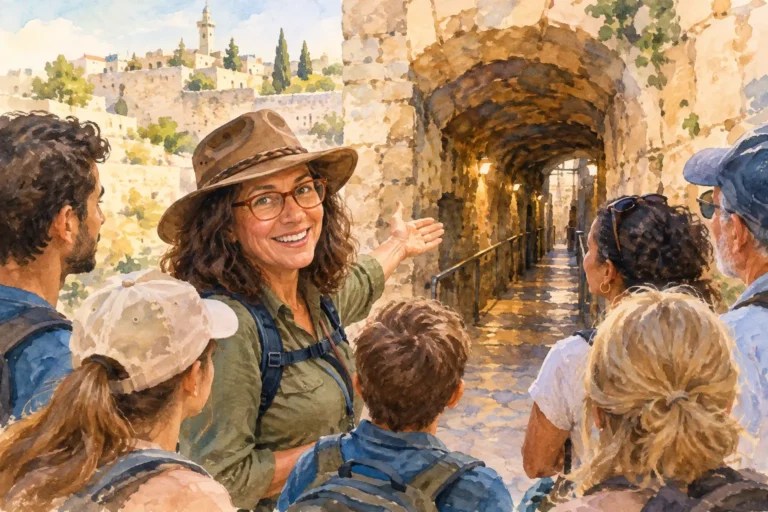
Jewish Quarter Tunnel Guide for Jerusalem
A Jerusalem street can tell one story, while the stone beneath it tells another. This Jewish Quarter tunnel guide is for travelers who want to understand that difference: not simply to walk through an underground passage, but to see how the city’s sacred geography, engineering, daily life, and centuries of rebuilding fit together.
The phrase “Jewish Quarter tunnel” can mean a few different experiences. Most often, visitors are referring to the Western Wall Tunnels, an underground route that follows the length of the Western Wall below the streets of the Muslim Quarter and near the edge of the Jewish Quarter. It is one of Jerusalem’s most memorable archaeological visits, but it is not a casual drop-in attraction. Entry is timed, security is part of the experience, and the route is best appreciated with enough context to understand what the stones are actually showing you.
What the Jewish Quarter tunnel experience reveals
At ground level, only a relatively short section of the Western Wall is visible in the prayer plaza. The tunnels reveal the far longer continuation of that retaining wall, built to support the expanded Temple Mount platform in the late Second Temple period. Walking alongside it is physically striking. The massive limestone blocks rise beside you, including stones so large that their transportation and placement still prompt genuine amazement.
Yet the scale is only part of the story. Below Jerusalem, each level represents a different chapter. You may encounter ancient street levels, vaulted spaces created in later periods, water-related features, and passages adapted as the city changed above them. This is why a good visit should not rush from one impressive stone to the next. The real pleasure is learning to read the layers.
On many routes, guides discuss features such as Wilson’s Arch, the ancient Western Wall stones, and sections associated with the city’s water systems. Exact stops can vary according to the tour route and site operations. That variation matters. One visit may focus more strongly on architecture and construction; another may spend more time on ritual life, pilgrimage, or the changing urban landscape.
For many Jewish travelers, the proximity to the Temple Mount and Western Wall gives the experience a powerful emotional dimension. For Christians and nonreligious visitors, it is equally compelling as a window into ancient Jerusalem’s layout and the remarkable endurance of a city built, destroyed, renewed, and continuously inhabited. You do not need prior religious knowledge to be moved by it. You do need a guide who can connect the archaeology to the Jerusalem visible outside.
Jewish Quarter tunnel guide: choosing the right visit
The Western Wall Tunnels are usually visited on an organized, timed tour. They are not a place to arrive at noon and expect immediate entry, particularly during busy travel periods, Jewish holidays, school vacations, and the spring and fall tourist seasons. Advance reservations are strongly recommended.
Before booking, consider what you want from the experience. A standard site tour is a good choice for travelers with limited time who want a reliable overview of the archaeology. A private Jerusalem day with a licensed guide is better when the tunnel visit is one piece of a wider story. It allows you to begin above ground, see the Jewish Quarter’s rebuilt streets and synagogues, pause at broad viewpoints, and then descend with a clearer sense of where you are.
That contrast makes a difference. In the tunnels, you are looking at the hidden foundation of a monumental project. Above ground, you can notice how Jerusalem’s neighborhoods, lanes, courtyards, and sacred places sit over and around those earlier worlds. A tailor-made route can also work well for a family with teenagers, a multigenerational group, or business travelers seeking a short but meaningful Jerusalem experience.
Private guiding does not replace the site’s own required admission procedures, and availability should always be confirmed before building the day around a specific tunnel departure. But it does give you the space to ask questions, move at your group’s pace, and place the visit within the broader Jewish Quarter rather than treating it as an isolated stop.
How much time should you allow?
Plan on roughly one to one and a half hours for the tunnel route itself, though timing can shift depending on the program and group pace. Add time for security, walking through the Old City, and finding the correct entrance. If your day includes the Jewish Quarter, allow at least half a day for a satisfying visit rather than trying to squeeze everything between two fixed appointments.
The Old City is compact on a map but not always quick on foot. Its stone lanes include steps, uneven surfaces, changing elevations, and moments when a busy passage slows everyone down. Travelers who prefer an easier pace should plan fewer stops and allow room for sitting, coffee, and a little unplanned wandering.
Is it suitable for children and older travelers?
Often, yes, but suitability depends on the person rather than the age printed on a passport. Curious older children generally enjoy the underground setting, the enormous stones, and the sense of entering a hidden city. Very young children may find a long explanatory tour difficult, while anyone uncomfortable in enclosed spaces should consider that carefully before booking.
The route involves walking and, in some sections, narrower passageways. Accessibility arrangements and route details can change, so travelers using a wheelchair, managing limited mobility, or traveling with a stroller should check the current options in advance. A thoughtful Jerusalem itinerary can always offer alternatives that preserve the historical depth without forcing a route that does not feel comfortable.
Practical preparation before you go
Wear comfortable walking shoes with a secure sole. Old City paving can be smooth in places and uneven in others, and the underground route is not the place for slippery sandals. The tunnels are generally cooler than Jerusalem’s streets, which can feel refreshing in summer, but a light layer is sensible in winter and on cooler evenings.
Bring water, especially if you are combining the visit with a longer Old City walk. Small bags are easier at security than large backpacks. Since the area is close to an active place of prayer, respectful clothing is appropriate, and a head covering may be useful depending on where your route begins or ends.
Photography policies can vary by section, and flash or tripods may not be permitted. More importantly, do not let the low light turn the entire visit into a camera exercise. Take a few photos, then look carefully at the wall itself: the dressed stone faces, the enormous lower courses, and the way later arches and rooms meet earlier masonry.
Friday afternoons, Saturdays, holidays, and religious observances can affect opening hours, traffic patterns, and the overall rhythm of the area. Jerusalem rewards planning, but it also rewards flexibility. Confirm the current schedule close to your visit and avoid building an itinerary with no breathing room.
Pairing the tunnels with the Jewish Quarter
The tunnel visit becomes richer when paired with sites that show life above the ancient retaining walls. Depending on your interests and time, that may mean the restored Jewish Quarter lanes, the Cardo, the archaeological remains of elite homes from the Second Temple period, the Burnt House, or a quiet rooftop view. These stops are close together geographically, but each tells a distinct story about worship, home life, trade, destruction, memory, and renewal.
Food can be part of the experience too. After the darkness and enclosed stone corridors, a simple lunch or coffee outside the Old City walls creates a welcome change of pace. For travelers who have visited Jerusalem before, the answer is not necessarily more sites. It may be a more focused conversation: how water reached the city, what a pilgrimage looked like, why certain stones are still visible, or how archaeology is interpreted when remains from many eras occupy the same small space.
A guide can shape that conversation around your own connection to Jerusalem, whether you are visiting for heritage, faith, family history, or pure curiosity. At Patchwork Israel, that personal approach is the heart of a meaningful day: begin with what interests you, then let the streets and stones lead you somewhere deeper.
When you step back into daylight after the tunnels, pause before moving on. Look at the street level around you and imagine how much of Jerusalem remains just below your feet. That small shift in perspective is often what stays with travelers longest.

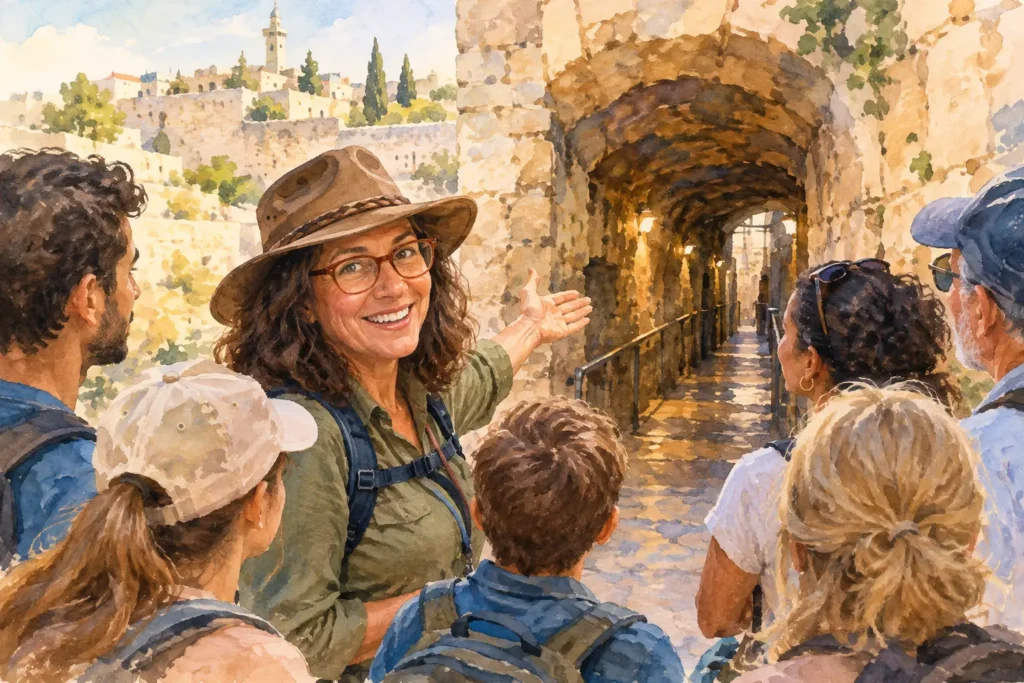
Jewish Quarter Tunnel Guide for Jerusalem
A Jerusalem street can tell one story, while the stone beneath it tells another. This Jewish Quarter tunnel guide is for travelers who want to understand that difference: not simply to walk through an underground passage, but to see how the city’s sacred geography, engineering, daily life, and centuries of rebuilding fit together.
The phrase “Jewish Quarter tunnel” can mean a few different experiences. Most often, visitors are referring to the Western Wall Tunnels, an underground route that follows the length of the Western Wall below the streets of the Muslim Quarter and near the edge of the Jewish Quarter. It is one of Jerusalem’s most memorable archaeological visits, but it is not a casual drop-in attraction. Entry is timed, security is part of the experience, and the route is best appreciated with enough context to understand what the stones are actually showing you.
What the Jewish Quarter tunnel experience reveals
At ground level, only a relatively short section of the Western Wall is visible in the prayer plaza. The tunnels reveal the far longer continuation of that retaining wall, built to support the expanded Temple Mount platform in the late Second Temple period. Walking alongside it is physically striking. The massive limestone blocks rise beside you, including stones so large that their transportation and placement still prompt genuine amazement.
Yet the scale is only part of the story. Below Jerusalem, each level represents a different chapter. You may encounter ancient street levels, vaulted spaces created in later periods, water-related features, and passages adapted as the city changed above them. This is why a good visit should not rush from one impressive stone to the next. The real pleasure is learning to read the layers.
On many routes, guides discuss features such as Wilson’s Arch, the ancient Western Wall stones, and sections associated with the city’s water systems. Exact stops can vary according to the tour route and site operations. That variation matters. One visit may focus more strongly on architecture and construction; another may spend more time on ritual life, pilgrimage, or the changing urban landscape.
For many Jewish travelers, the proximity to the Temple Mount and Western Wall gives the experience a powerful emotional dimension. For Christians and nonreligious visitors, it is equally compelling as a window into ancient Jerusalem’s layout and the remarkable endurance of a city built, destroyed, renewed, and continuously inhabited. You do not need prior religious knowledge to be moved by it. You do need a guide who can connect the archaeology to the Jerusalem visible outside.
Jewish Quarter tunnel guide: choosing the right visit
The Western Wall Tunnels are usually visited on an organized, timed tour. They are not a place to arrive at noon and expect immediate entry, particularly during busy travel periods, Jewish holidays, school vacations, and the spring and fall tourist seasons. Advance reservations are strongly recommended.
Before booking, consider what you want from the experience. A standard site tour is a good choice for travelers with limited time who want a reliable overview of the archaeology. A private Jerusalem day with a licensed guide is better when the tunnel visit is one piece of a wider story. It allows you to begin above ground, see the Jewish Quarter’s rebuilt streets and synagogues, pause at broad viewpoints, and then descend with a clearer sense of where you are.
That contrast makes a difference. In the tunnels, you are looking at the hidden foundation of a monumental project. Above ground, you can notice how Jerusalem’s neighborhoods, lanes, courtyards, and sacred places sit over and around those earlier worlds. A tailor-made route can also work well for a family with teenagers, a multigenerational group, or business travelers seeking a short but meaningful Jerusalem experience.
Private guiding does not replace the site’s own required admission procedures, and availability should always be confirmed before building the day around a specific tunnel departure. But it does give you the space to ask questions, move at your group’s pace, and place the visit within the broader Jewish Quarter rather than treating it as an isolated stop.
How much time should you allow?
Plan on roughly one to one and a half hours for the tunnel route itself, though timing can shift depending on the program and group pace. Add time for security, walking through the Old City, and finding the correct entrance. If your day includes the Jewish Quarter, allow at least half a day for a satisfying visit rather than trying to squeeze everything between two fixed appointments.
The Old City is compact on a map but not always quick on foot. Its stone lanes include steps, uneven surfaces, changing elevations, and moments when a busy passage slows everyone down. Travelers who prefer an easier pace should plan fewer stops and allow room for sitting, coffee, and a little unplanned wandering.
Is it suitable for children and older travelers?
Often, yes, but suitability depends on the person rather than the age printed on a passport. Curious older children generally enjoy the underground setting, the enormous stones, and the sense of entering a hidden city. Very young children may find a long explanatory tour difficult, while anyone uncomfortable in enclosed spaces should consider that carefully before booking.
The route involves walking and, in some sections, narrower passageways. Accessibility arrangements and route details can change, so travelers using a wheelchair, managing limited mobility, or traveling with a stroller should check the current options in advance. A thoughtful Jerusalem itinerary can always offer alternatives that preserve the historical depth without forcing a route that does not feel comfortable.
Practical preparation before you go
Wear comfortable walking shoes with a secure sole. Old City paving can be smooth in places and uneven in others, and the underground route is not the place for slippery sandals. The tunnels are generally cooler than Jerusalem’s streets, which can feel refreshing in summer, but a light layer is sensible in winter and on cooler evenings.
Bring water, especially if you are combining the visit with a longer Old City walk. Small bags are easier at security than large backpacks. Since the area is close to an active place of prayer, respectful clothing is appropriate, and a head covering may be useful depending on where your route begins or ends.
Photography policies can vary by section, and flash or tripods may not be permitted. More importantly, do not let the low light turn the entire visit into a camera exercise. Take a few photos, then look carefully at the wall itself: the dressed stone faces, the enormous lower courses, and the way later arches and rooms meet earlier masonry.
Friday afternoons, Saturdays, holidays, and religious observances can affect opening hours, traffic patterns, and the overall rhythm of the area. Jerusalem rewards planning, but it also rewards flexibility. Confirm the current schedule close to your visit and avoid building an itinerary with no breathing room.
Pairing the tunnels with the Jewish Quarter
The tunnel visit becomes richer when paired with sites that show life above the ancient retaining walls. Depending on your interests and time, that may mean the restored Jewish Quarter lanes, the Cardo, the archaeological remains of elite homes from the Second Temple period, the Burnt House, or a quiet rooftop view. These stops are close together geographically, but each tells a distinct story about worship, home life, trade, destruction, memory, and renewal.
Food can be part of the experience too. After the darkness and enclosed stone corridors, a simple lunch or coffee outside the Old City walls creates a welcome change of pace. For travelers who have visited Jerusalem before, the answer is not necessarily more sites. It may be a more focused conversation: how water reached the city, what a pilgrimage looked like, why certain stones are still visible, or how archaeology is interpreted when remains from many eras occupy the same small space.
A guide can shape that conversation around your own connection to Jerusalem, whether you are visiting for heritage, faith, family history, or pure curiosity. At Patchwork Israel, that personal approach is the heart of a meaningful day: begin with what interests you, then let the streets and stones lead you somewhere deeper.
When you step back into daylight after the tunnels, pause before moving on. Look at the street level around you and imagine how much of Jerusalem remains just below your feet. That small shift in perspective is often what stays with travelers longest.


Get the latest blog updates in your inbox.