
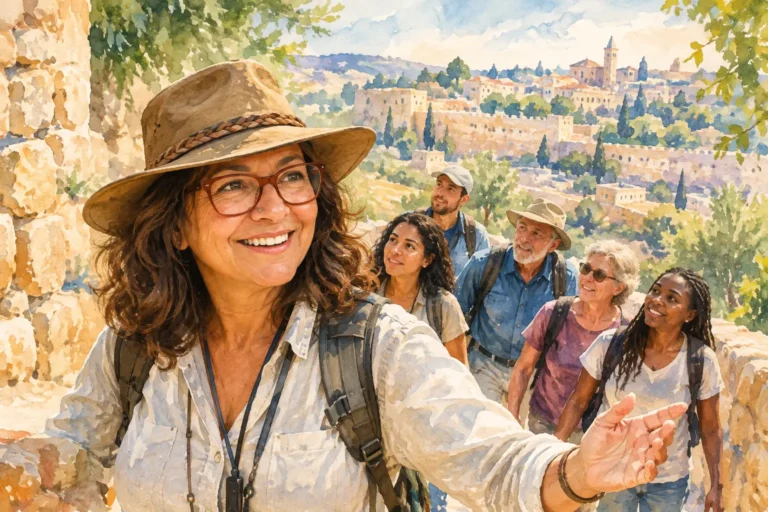
Walking in the Footsteps of Our Ancestors in Judaism
Walking in the footsteps of our ancestors in Judaism is not simply about standing at an ancient wall or photographing a familiar skyline. It is the moment when a line from the siddur, a family custom at the Passover table, or a story told by a grandparent suddenly has a setting, a scent, and a landscape. In Israel, memory is not kept behind museum glass. It is woven into hillsides, alleyways, synagogues, marketplaces, burial caves, and the rhythm of an ordinary Friday afternoon.
For many Jewish travelers, this kind of journey is deeply personal. Some arrive with a strong religious practice; others come with questions, a family name, or a desire to understand where Jewish continuity lives in real places. There is room for all of that. A meaningful heritage journey does not require anyone to perform a feeling they do not have. It asks only for curiosity and a willingness to slow down.
Walking in the Footsteps of Our Ancestors in Judaism
The Jewish story has never belonged to one landscape alone. It was shaped across generations and continents, carried through languages, migrations, prayer traditions, recipes, and family memories. Yet Israel offers an unusually immediate way to encounter many of its foundations. Here, biblical geography, Second Temple history, rabbinic learning, medieval pilgrimage, modern renewal, and daily Jewish life can be experienced within one journey.
That proximity changes the conversation. Instead of hearing that Jerusalem was central to Jewish longing, you can notice how the city’s stone streets rise and fall beneath your feet. Instead of reading about the desert as a place of testing, refuge, and revelation, you can feel its open silence at first light. Instead of treating a holiday as an abstract date on a calendar, you can see preparations unfolding in neighborhoods, bakeries, and family kitchens.
The goal is not to claim that every stop belonged to a particular ancestor. Most families cannot trace a direct line to a specific ancient street or hillside, and there is no need to invent one. The connection is broader and, in many ways, more powerful: these are places where generations of Jews prayed, studied, argued, mourned, celebrated, and imagined a future.
Let the Journey Follow Your Own Jewish Story
The strongest heritage itineraries begin with a simple question: what are you hoping to understand? A family traveling with teenagers may want a lively blend of hands-on archaeology, food, nature, and major landmarks. A couple returning to Israel after many years may prefer lesser-known neighborhoods, intimate conversations, and time to reflect. A business traveler with one free day may want a concentrated experience that feels grounded rather than rushed.
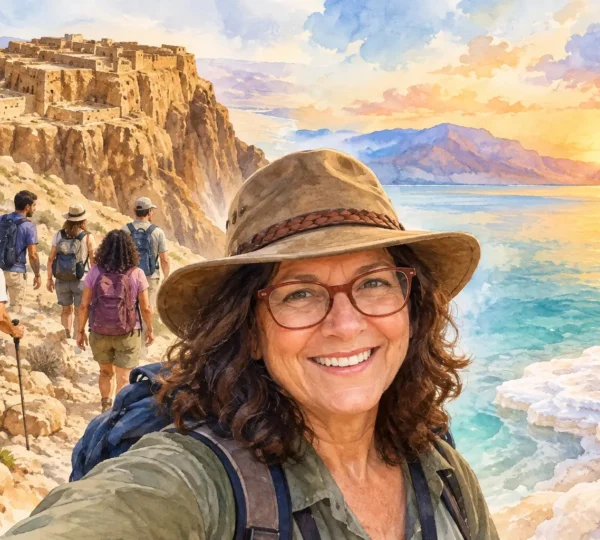
A visit to Jerusalem can be built around the Jewish calendar, the city’s changing quarters, or the physical topography that shaped daily life thousands of years ago. In the Galilee, the focus may shift to landscapes associated with early Jewish communities, ancient synagogue remains, and the practical realities of farming and village life. Around the Dead Sea and Masada, the drama of the desert opens a different chapter, one that brings resilience, ritual practice, and human choices into view.
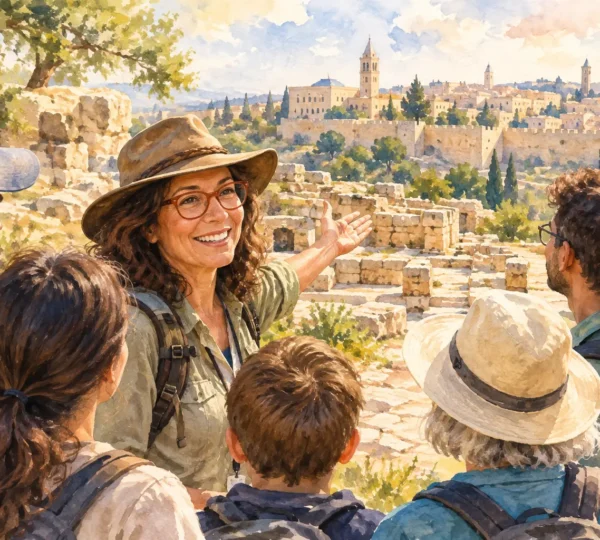
Even familiar sites deserve more than a checklist approach. What matters is context: why a place became sacred, what changed there over time, and how people relate to it now. A licensed guide can help connect those layers without turning the day into a lecture. Sometimes the most memorable moment is not the headline site, but a quiet overlook, a carved inscription, or a conversation that makes a historical period feel close.
Make space for the everyday
Jewish heritage is found in major archaeological sites, but it also lives in ordinary details. The aroma of challah before Shabbat, the careful arrangement of a small synagogue, handwritten notices on a community board, and the sound of Hebrew spoken in daily errands all reveal something that ruins alone cannot.
This is especially valuable for travelers whose connection to Judaism is cultural, familial, or still taking shape. A private journey can include time in a market, a cooking experience, a neighborhood walk, or a visit with people whose work and lives offer a personal window into contemporary Israel. These encounters do not replace history. They give it a human voice.
Places That Invite Reflection, Not Just Photos
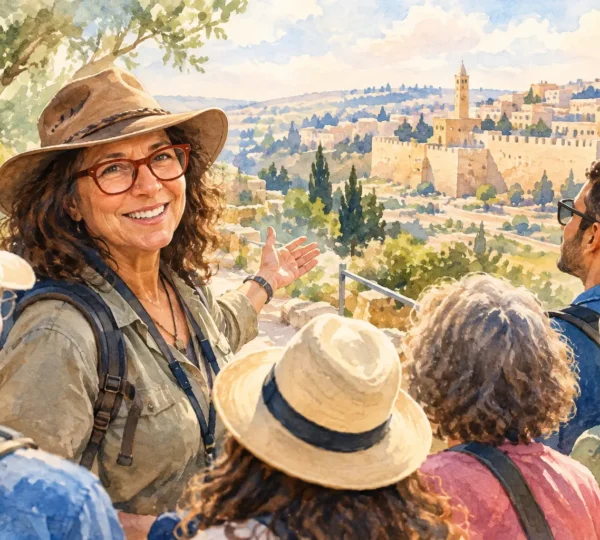
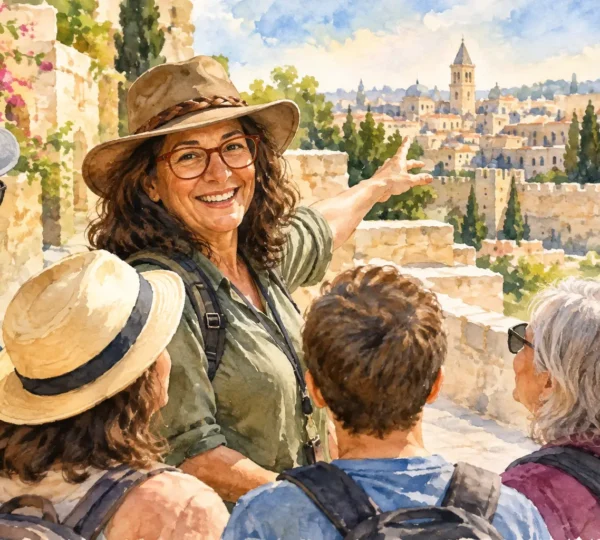
Jerusalem naturally holds a central place in many Jewish heritage journeys. Its intensity can be overwhelming if approached too quickly, so pacing matters. Spend time understanding the city’s geography before moving through its better-known sacred spaces. Notice the routes people took, the water systems that supported settlement, and the views that explain why this ridge became so significant.
The City of David and the areas surrounding the Old City can add rich archaeological perspective, while the Jewish Quarter offers layers of rebuilding, learning, and communal life. A visit to the Western Wall may be profoundly moving, whether you come to pray, observe, or simply absorb the quiet concentration of those around you. It is also a place where etiquette and timing matter, particularly on Shabbat and Jewish holidays.
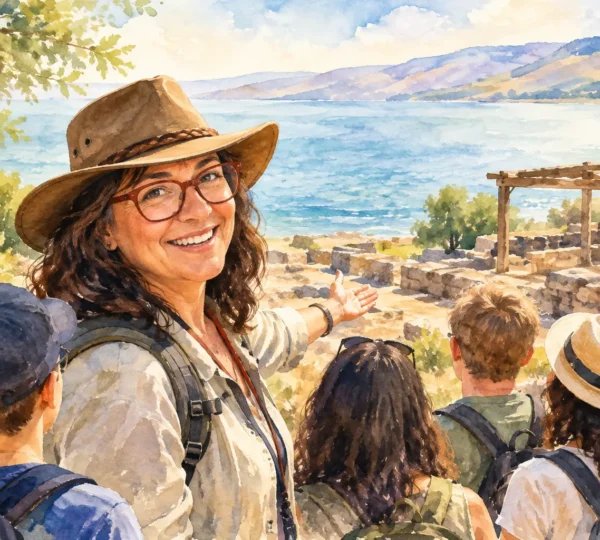
In the north, ancient synagogue sites and the green contours of the Galilee offer a different emotional register. Here, it is easier to imagine communities living alongside fields, roads, and seasonal weather. The landscape encourages a slower day, perhaps with a walk suited to your group’s ability, a local meal, and time to consider how Jewish learning continued and evolved after the destruction of the Second Temple.
The desert offers contrast. At Masada, visitors often arrive expecting only a dramatic fortress. The fuller experience comes from asking harder questions about evidence, memory, and the ways stories are passed on. Nearby, the Dead Sea’s striking terrain and the Judean Desert’s vast horizons create room for both adventure and contemplation. An early hike, a 4×4 route, or a carefully chosen lookout can make the region feel less like a stop between destinations and more like a chapter in its own right.
The Value of Asking Better Questions
Heritage travel becomes meaningful when it moves beyond, “What happened here?” Try asking, “What did this place mean to the people who came before us?” “Which practices survived because families kept repeating them?” “What feels familiar to me, and what surprises me?”
These questions make room for complexity. Jewish history includes joy and grief, continuity and change, certainty and debate. A good journey does not flatten those tensions into a simple story. It helps travelers encounter them with respect and leave with a more honest connection.
Children and teens often respond especially well when the experience is active. Walking through a water tunnel, examining an excavation, baking a traditional food, or hiking to a viewpoint gives them a way into the story that does not depend on sitting still and listening. Adults, too, benefit from variety. A day with a single pace and one type of experience can feel long, even at extraordinary sites.
Plan for Meaning, Not Maximum Coverage
There is a temptation to fit every major destination into a limited itinerary. That approach can work for travelers who want a broad first introduction, but heritage-focused travel usually benefits from fewer stops and more time at each one. One unhurried afternoon in Jerusalem may stay with you longer than a rushed circuit through five locations.
Practical choices matter. Consider the season, your group’s walking comfort, Shabbat hours, dietary preferences, and the emotional weight of certain sites. Build in pauses for coffee, conversation, and simply looking around. Israel is compact on a map, but roads, terrain, and the desire to be present all affect what is realistic in a day.
At Patchwork Israel, a private itinerary can be shaped around the version of this journey that matters to you: family roots, Jewish history, spiritual reflection, outdoor exploration, or a blend of all of them. The most rewarding days are rarely the ones that try to prove you have seen everything. They are the ones that leave you with a story you will continue discussing at home.
Bring your questions, your family anecdotes, and perhaps a few names you have heard all your life. Then allow the land to add its own voice. A meaningful Jewish journey is not about retracing the past perfectly. It is about recognizing that you are part of a living story, and choosing where to take your next step.

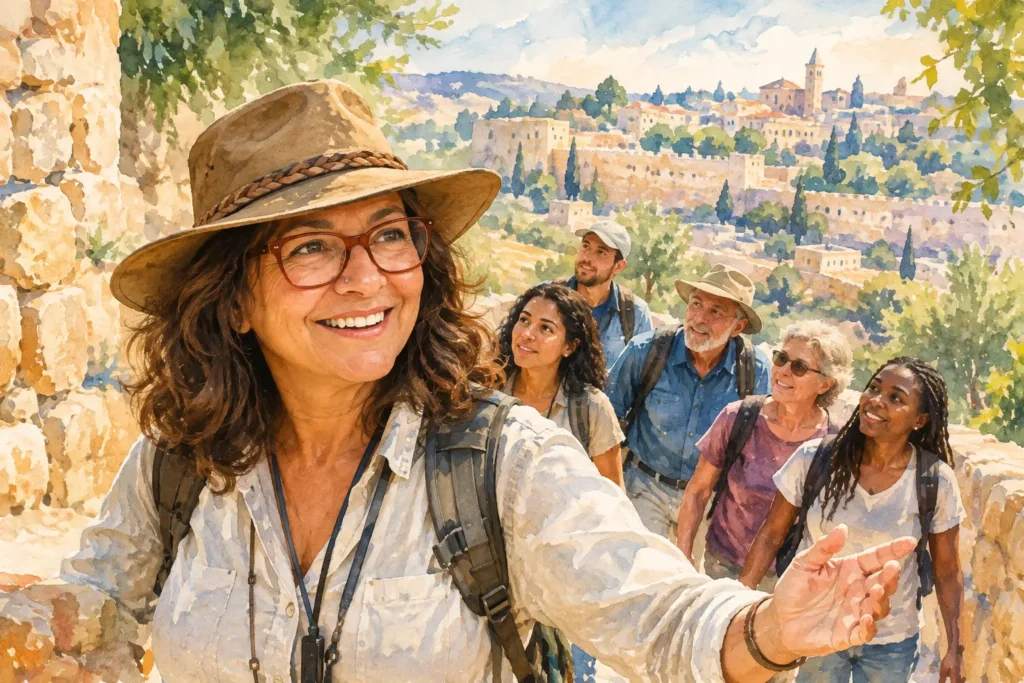
Walking in the Footsteps of Our Ancestors in Judaism
Walking in the footsteps of our ancestors in Judaism is not simply about standing at an ancient wall or photographing a familiar skyline. It is the moment when a line from the siddur, a family custom at the Passover table, or a story told by a grandparent suddenly has a setting, a scent, and a landscape. In Israel, memory is not kept behind museum glass. It is woven into hillsides, alleyways, synagogues, marketplaces, burial caves, and the rhythm of an ordinary Friday afternoon.
For many Jewish travelers, this kind of journey is deeply personal. Some arrive with a strong religious practice; others come with questions, a family name, or a desire to understand where Jewish continuity lives in real places. There is room for all of that. A meaningful heritage journey does not require anyone to perform a feeling they do not have. It asks only for curiosity and a willingness to slow down.
Walking in the Footsteps of Our Ancestors in Judaism
The Jewish story has never belonged to one landscape alone. It was shaped across generations and continents, carried through languages, migrations, prayer traditions, recipes, and family memories. Yet Israel offers an unusually immediate way to encounter many of its foundations. Here, biblical geography, Second Temple history, rabbinic learning, medieval pilgrimage, modern renewal, and daily Jewish life can be experienced within one journey.
That proximity changes the conversation. Instead of hearing that Jerusalem was central to Jewish longing, you can notice how the city’s stone streets rise and fall beneath your feet. Instead of reading about the desert as a place of testing, refuge, and revelation, you can feel its open silence at first light. Instead of treating a holiday as an abstract date on a calendar, you can see preparations unfolding in neighborhoods, bakeries, and family kitchens.
The goal is not to claim that every stop belonged to a particular ancestor. Most families cannot trace a direct line to a specific ancient street or hillside, and there is no need to invent one. The connection is broader and, in many ways, more powerful: these are places where generations of Jews prayed, studied, argued, mourned, celebrated, and imagined a future.
Let the Journey Follow Your Own Jewish Story
The strongest heritage itineraries begin with a simple question: what are you hoping to understand? A family traveling with teenagers may want a lively blend of hands-on archaeology, food, nature, and major landmarks. A couple returning to Israel after many years may prefer lesser-known neighborhoods, intimate conversations, and time to reflect. A business traveler with one free day may want a concentrated experience that feels grounded rather than rushed.
A visit to Jerusalem can be built around the Jewish calendar, the city’s changing quarters, or the physical topography that shaped daily life thousands of years ago. In the Galilee, the focus may shift to landscapes associated with early Jewish communities, ancient synagogue remains, and the practical realities of farming and village life. Around the Dead Sea and Masada, the drama of the desert opens a different chapter, one that brings resilience, ritual practice, and human choices into view.
Even familiar sites deserve more than a checklist approach. What matters is context: why a place became sacred, what changed there over time, and how people relate to it now. A licensed guide can help connect those layers without turning the day into a lecture. Sometimes the most memorable moment is not the headline site, but a quiet overlook, a carved inscription, or a conversation that makes a historical period feel close.
Make space for the everyday
Jewish heritage is found in major archaeological sites, but it also lives in ordinary details. The aroma of challah before Shabbat, the careful arrangement of a small synagogue, handwritten notices on a community board, and the sound of Hebrew spoken in daily errands all reveal something that ruins alone cannot.
This is especially valuable for travelers whose connection to Judaism is cultural, familial, or still taking shape. A private journey can include time in a market, a cooking experience, a neighborhood walk, or a visit with people whose work and lives offer a personal window into contemporary Israel. These encounters do not replace history. They give it a human voice.
Places That Invite Reflection, Not Just Photos
Jerusalem naturally holds a central place in many Jewish heritage journeys. Its intensity can be overwhelming if approached too quickly, so pacing matters. Spend time understanding the city’s geography before moving through its better-known sacred spaces. Notice the routes people took, the water systems that supported settlement, and the views that explain why this ridge became so significant.
The City of David and the areas surrounding the Old City can add rich archaeological perspective, while the Jewish Quarter offers layers of rebuilding, learning, and communal life. A visit to the Western Wall may be profoundly moving, whether you come to pray, observe, or simply absorb the quiet concentration of those around you. It is also a place where etiquette and timing matter, particularly on Shabbat and Jewish holidays.
In the north, ancient synagogue sites and the green contours of the Galilee offer a different emotional register. Here, it is easier to imagine communities living alongside fields, roads, and seasonal weather. The landscape encourages a slower day, perhaps with a walk suited to your group’s ability, a local meal, and time to consider how Jewish learning continued and evolved after the destruction of the Second Temple.
The desert offers contrast. At Masada, visitors often arrive expecting only a dramatic fortress. The fuller experience comes from asking harder questions about evidence, memory, and the ways stories are passed on. Nearby, the Dead Sea’s striking terrain and the Judean Desert’s vast horizons create room for both adventure and contemplation. An early hike, a 4×4 route, or a carefully chosen lookout can make the region feel less like a stop between destinations and more like a chapter in its own right.
The Value of Asking Better Questions
Heritage travel becomes meaningful when it moves beyond, “What happened here?” Try asking, “What did this place mean to the people who came before us?” “Which practices survived because families kept repeating them?” “What feels familiar to me, and what surprises me?”
These questions make room for complexity. Jewish history includes joy and grief, continuity and change, certainty and debate. A good journey does not flatten those tensions into a simple story. It helps travelers encounter them with respect and leave with a more honest connection.
Children and teens often respond especially well when the experience is active. Walking through a water tunnel, examining an excavation, baking a traditional food, or hiking to a viewpoint gives them a way into the story that does not depend on sitting still and listening. Adults, too, benefit from variety. A day with a single pace and one type of experience can feel long, even at extraordinary sites.
Plan for Meaning, Not Maximum Coverage
There is a temptation to fit every major destination into a limited itinerary. That approach can work for travelers who want a broad first introduction, but heritage-focused travel usually benefits from fewer stops and more time at each one. One unhurried afternoon in Jerusalem may stay with you longer than a rushed circuit through five locations.
Practical choices matter. Consider the season, your group’s walking comfort, Shabbat hours, dietary preferences, and the emotional weight of certain sites. Build in pauses for coffee, conversation, and simply looking around. Israel is compact on a map, but roads, terrain, and the desire to be present all affect what is realistic in a day.
At Patchwork Israel, a private itinerary can be shaped around the version of this journey that matters to you: family roots, Jewish history, spiritual reflection, outdoor exploration, or a blend of all of them. The most rewarding days are rarely the ones that try to prove you have seen everything. They are the ones that leave you with a story you will continue discussing at home.
Bring your questions, your family anecdotes, and perhaps a few names you have heard all your life. Then allow the land to add its own voice. A meaningful Jewish journey is not about retracing the past perfectly. It is about recognizing that you are part of a living story, and choosing where to take your next step.
Get the latest blog updates in your inbox.