
How to Visit Magdala Thoughtfully and Well
Magdala can look like a quick stop on a busy Galilee itinerary. That would be a missed opportunity. Knowing how to visit Magdala thoughtfully means allowing this small place on the western shore of the Sea of Galilee to be more than a photo stop or a name connected with Mary Magdalene. It is a place where daily life, Jewish history, early Christian memory, archaeology, and the landscape of the Galilee meet in a remarkably intimate way.
The site rewards visitors who slow down. Its ancient stones do not need dramatic staging. A few well-chosen questions, a little time to walk quietly, and an awareness of what you are seeing can turn a visit into one of the most personal moments of a journey through northern Israel.
Begin with the place, not only the person
Many visitors arrive thinking first of Mary Magdalene, traditionally associated with Magdala. That connection can be spiritually powerful, particularly for Christian travelers, but the archaeological remains tell a wider story. Magdala was a thriving Jewish town during the first century, positioned near the lake and sustained by fishing, trade, agriculture, and the movement of people through the Galilee.
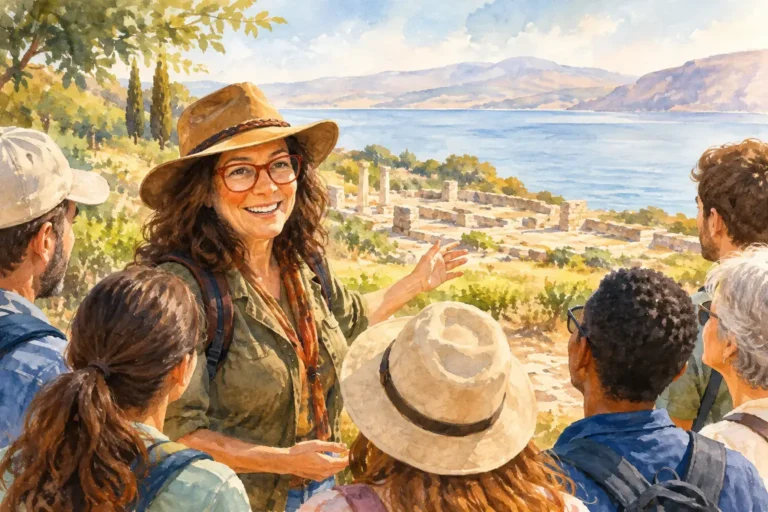
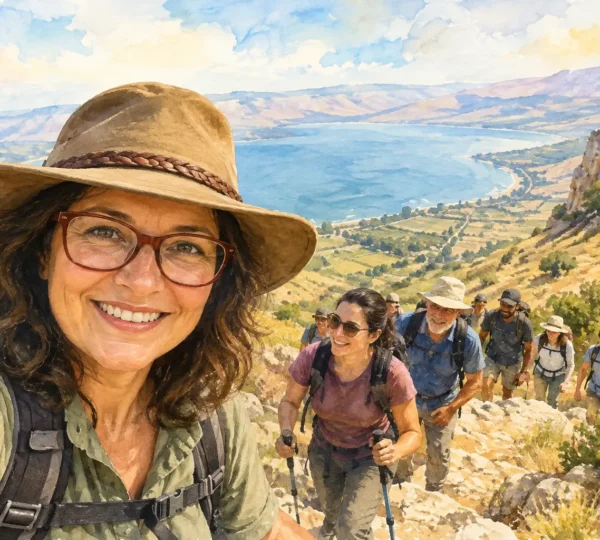
Start by noticing its setting. The Sea of Galilee is close, the hills rise beyond it, and the surrounding region makes clear why this was not an isolated village. This was a lived-in lakeside town. Families worked here. Goods moved through here. Religious life took place here. Understanding that ordinary human setting brings the site closer than a dramatic retelling ever could.
For Jewish visitors, Magdala offers a particularly vivid encounter with Jewish life in the late Second Temple period. For travelers with Christian interests, it adds texture to the world in which Jesus taught and traveled. For those who are not traveling for religious reasons, it is still an extraordinary archaeological window into a compact, active community nearly two thousand years ago.
Give the ancient synagogue your full attention
The first-century synagogue is the heart of an unhurried visit. It is among the most meaningful discoveries at Magdala because it provides rare physical evidence of communal Jewish worship in the Galilee during that era. Do not rush around its edges simply to take a photograph. Stand for a moment and consider the scale of the room, the stone benches, and the fact that people gathered here to hear scripture and discuss their shared life.
The Magdala Stone deserves especially careful attention. Its carved imagery, including a representation associated with the Temple in Jerusalem, connects this Galilean town to the religious center of Jewish life. It is a small object with a large story. Rather than trying to absorb every scholarly detail at once, ask one simple question: what did this image mean to the people who gathered in this room?
A good guide can help distinguish between what archaeologists know from the material evidence, what is likely based on historical context, and what belongs to later tradition. That distinction matters. It does not make the visit less meaningful. It makes the experience more honest, and often more moving.
How to visit Magdala thoughtfully as a sacred space
Magdala is both an archaeological site and a place of prayer for many visitors. The modern spiritual areas, including the Duc in Altum chapel, are designed for reflection and should be approached with the same care you would bring to an active house of worship.
Dress modestly, keep voices low, and be aware that another visitor may be praying, attending a service, or sitting quietly with a personal memory. Photography may be welcome in some areas and limited in others, so follow posted guidance and the direction of staff. A thoughtful visitor does not treat a sacred setting as a backdrop.
If you are part of a faith-based group, resist the temptation to fill every minute with readings or group commentary. Choose one meaningful passage or reflection, then leave room for silence. If you are traveling with family members of different beliefs, Magdala can also be a gracious place for shared conversation. One person may connect with the archaeology, another with the spiritual setting, and another with the lake itself.
Let archaeology remain archaeology
One of the great pleasures of Magdala is that it invites imagination. The remains of streets, markets, ritual baths, and industrial spaces make it easy to picture a working town. Imagination is useful, but it should be anchored in what is actually there.
The ritual baths, known as mikvaot, are especially striking. Their presence reflects the importance of ritual practice in the town, while their water system reveals practical knowledge of the landscape. Take time to look beyond the label. Notice how architecture, water, faith, and everyday routine were connected.
It is tempting at historic sites to seek a single perfect story, especially one that confirms what we already hope to find. Magdala asks for something better: curiosity. There are elements of the site that scholars continue to study and interpret. That is not a weakness. It is part of the privilege of visiting a place where discovery is still ongoing.
Plan enough time, but not too much
For many travelers, about 60 to 90 minutes is enough to explore Magdala with care. A visitor who wants to pray, attend a service, study the archaeology in more detail, or simply sit with the view may want closer to two hours. The right pace depends on your interests and on the rhythm of the rest of your day.
Magdala pairs naturally with other Galilee experiences, but it should not be squeezed between too many stops. A full day that includes lakeside sites, a village or market experience, and a relaxed local meal can be wonderful. On the other hand, if your itinerary already includes several major religious sites, Magdala may be best visited early in the day, when your attention is fresh and the atmosphere is quieter.
Travelers short on time should choose depth over quantity. It is better to see the synagogue, archaeological remains, and spiritual areas with genuine attention than to hurry through Magdala only to say it was included.
Make room for the living Galilee
Thoughtful travel does not stop at ancient stones. The Galilee is a living region of farms, kitchens, trails, communities, and changing seasonal color. After Magdala, consider continuing your day in a way that keeps you connected to the landscape rather than immediately retreating to the bus or car.
A gentle walk near the lake, a meal shaped by regional ingredients, or a scenic drive into the hills can help place Magdala in its broader environment. In spring, the greenery and wildflowers can make the area feel especially open and alive. Summer brings bright lake light and heat, so early visits are often more comfortable. Winter can be quieter and atmospheric, though weather calls for flexibility.
This is where a tailor-made day has real value. A family may need shade, shorter walks, and a relaxed lunch. A heritage traveler may prefer more archaeological context. A returning visitor might combine Magdala with a lesser-known trail, a culinary stop, or a conversation that adds another layer to the Galilee. At Patchwork Israel, that kind of adjustment is not an afterthought. It is the point of traveling with someone who knows when to linger and when to move on.
Bring the right questions
You do not need to arrive with expert knowledge. A few open questions will deepen the visit: What did daily life require in this town? How did the lake shape its economy? What does this synagogue reveal about communal life? Why does this place matter to people today?
If you are traveling with children or teens, invite them to look for evidence of real life rather than asking them to memorize dates. Where did people get water? What would they have heard on a busy day? Which spaces feel public, and which feel private? These questions make the ruins human and encourage observation rather than passive sightseeing.
Before leaving, take one last look toward the lake. Magdala is not meaningful because it supplies a simple answer to the past. It is meaningful because it leaves room for history, faith, and personal reflection to sit beside one another. Give it that room, and the visit is likely to remain with you long after the Galilee is behind you.

How to Visit Magdala Thoughtfully and Well
Magdala can look like a quick stop on a busy Galilee itinerary. That would be a missed opportunity. Knowing how to visit Magdala thoughtfully means allowing this small place on the western shore of the Sea of Galilee to be more than a photo stop or a name connected with Mary Magdalene. It is a place where daily life, Jewish history, early Christian memory, archaeology, and the landscape of the Galilee meet in a remarkably intimate way.
The site rewards visitors who slow down. Its ancient stones do not need dramatic staging. A few well-chosen questions, a little time to walk quietly, and an awareness of what you are seeing can turn a visit into one of the most personal moments of a journey through northern Israel.
Begin with the place, not only the person
Many visitors arrive thinking first of Mary Magdalene, traditionally associated with Magdala. That connection can be spiritually powerful, particularly for Christian travelers, but the archaeological remains tell a wider story. Magdala was a thriving Jewish town during the first century, positioned near the lake and sustained by fishing, trade, agriculture, and the movement of people through the Galilee.
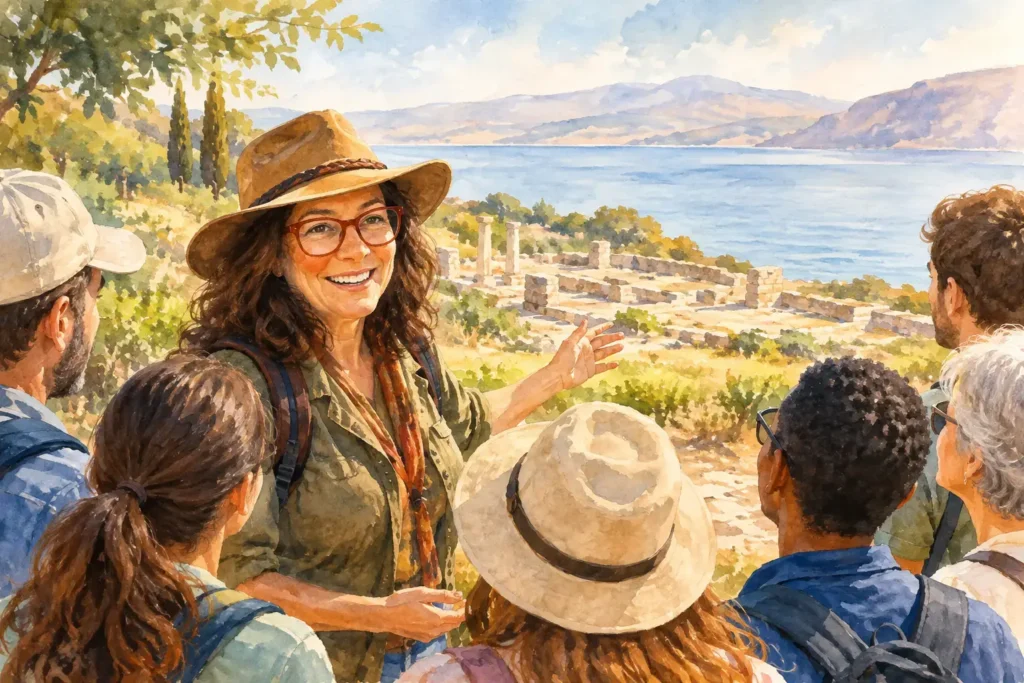
Start by noticing its setting. The Sea of Galilee is close, the hills rise beyond it, and the surrounding region makes clear why this was not an isolated village. This was a lived-in lakeside town. Families worked here. Goods moved through here. Religious life took place here. Understanding that ordinary human setting brings the site closer than a dramatic retelling ever could.
For Jewish visitors, Magdala offers a particularly vivid encounter with Jewish life in the late Second Temple period. For travelers with Christian interests, it adds texture to the world in which Jesus taught and traveled. For those who are not traveling for religious reasons, it is still an extraordinary archaeological window into a compact, active community nearly two thousand years ago.
Give the ancient synagogue your full attention
The first-century synagogue is the heart of an unhurried visit. It is among the most meaningful discoveries at Magdala because it provides rare physical evidence of communal Jewish worship in the Galilee during that era. Do not rush around its edges simply to take a photograph. Stand for a moment and consider the scale of the room, the stone benches, and the fact that people gathered here to hear scripture and discuss their shared life.
The Magdala Stone deserves especially careful attention. Its carved imagery, including a representation associated with the Temple in Jerusalem, connects this Galilean town to the religious center of Jewish life. It is a small object with a large story. Rather than trying to absorb every scholarly detail at once, ask one simple question: what did this image mean to the people who gathered in this room?
A good guide can help distinguish between what archaeologists know from the material evidence, what is likely based on historical context, and what belongs to later tradition. That distinction matters. It does not make the visit less meaningful. It makes the experience more honest, and often more moving.
How to visit Magdala thoughtfully as a sacred space
Magdala is both an archaeological site and a place of prayer for many visitors. The modern spiritual areas, including the Duc in Altum chapel, are designed for reflection and should be approached with the same care you would bring to an active house of worship.
Dress modestly, keep voices low, and be aware that another visitor may be praying, attending a service, or sitting quietly with a personal memory. Photography may be welcome in some areas and limited in others, so follow posted guidance and the direction of staff. A thoughtful visitor does not treat a sacred setting as a backdrop.
If you are part of a faith-based group, resist the temptation to fill every minute with readings or group commentary. Choose one meaningful passage or reflection, then leave room for silence. If you are traveling with family members of different beliefs, Magdala can also be a gracious place for shared conversation. One person may connect with the archaeology, another with the spiritual setting, and another with the lake itself.
Let archaeology remain archaeology
One of the great pleasures of Magdala is that it invites imagination. The remains of streets, markets, ritual baths, and industrial spaces make it easy to picture a working town. Imagination is useful, but it should be anchored in what is actually there.
The ritual baths, known as mikvaot, are especially striking. Their presence reflects the importance of ritual practice in the town, while their water system reveals practical knowledge of the landscape. Take time to look beyond the label. Notice how architecture, water, faith, and everyday routine were connected.
It is tempting at historic sites to seek a single perfect story, especially one that confirms what we already hope to find. Magdala asks for something better: curiosity. There are elements of the site that scholars continue to study and interpret. That is not a weakness. It is part of the privilege of visiting a place where discovery is still ongoing.
Plan enough time, but not too much
For many travelers, about 60 to 90 minutes is enough to explore Magdala with care. A visitor who wants to pray, attend a service, study the archaeology in more detail, or simply sit with the view may want closer to two hours. The right pace depends on your interests and on the rhythm of the rest of your day.
Magdala pairs naturally with other Galilee experiences, but it should not be squeezed between too many stops. A full day that includes lakeside sites, a village or market experience, and a relaxed local meal can be wonderful. On the other hand, if your itinerary already includes several major religious sites, Magdala may be best visited early in the day, when your attention is fresh and the atmosphere is quieter.
Travelers short on time should choose depth over quantity. It is better to see the synagogue, archaeological remains, and spiritual areas with genuine attention than to hurry through Magdala only to say it was included.
Make room for the living Galilee
Thoughtful travel does not stop at ancient stones. The Galilee is a living region of farms, kitchens, trails, communities, and changing seasonal color. After Magdala, consider continuing your day in a way that keeps you connected to the landscape rather than immediately retreating to the bus or car.
A gentle walk near the lake, a meal shaped by regional ingredients, or a scenic drive into the hills can help place Magdala in its broader environment. In spring, the greenery and wildflowers can make the area feel especially open and alive. Summer brings bright lake light and heat, so early visits are often more comfortable. Winter can be quieter and atmospheric, though weather calls for flexibility.
This is where a tailor-made day has real value. A family may need shade, shorter walks, and a relaxed lunch. A heritage traveler may prefer more archaeological context. A returning visitor might combine Magdala with a lesser-known trail, a culinary stop, or a conversation that adds another layer to the Galilee. At Patchwork Israel, that kind of adjustment is not an afterthought. It is the point of traveling with someone who knows when to linger and when to move on.
Bring the right questions
You do not need to arrive with expert knowledge. A few open questions will deepen the visit: What did daily life require in this town? How did the lake shape its economy? What does this synagogue reveal about communal life? Why does this place matter to people today?
If you are traveling with children or teens, invite them to look for evidence of real life rather than asking them to memorize dates. Where did people get water? What would they have heard on a busy day? Which spaces feel public, and which feel private? These questions make the ruins human and encourage observation rather than passive sightseeing.
Before leaving, take one last look toward the lake. Magdala is not meaningful because it supplies a simple answer to the past. It is meaningful because it leaves room for history, faith, and personal reflection to sit beside one another. Give it that room, and the visit is likely to remain with you long after the Galilee is behind you.
Get the latest blog updates in your inbox.