
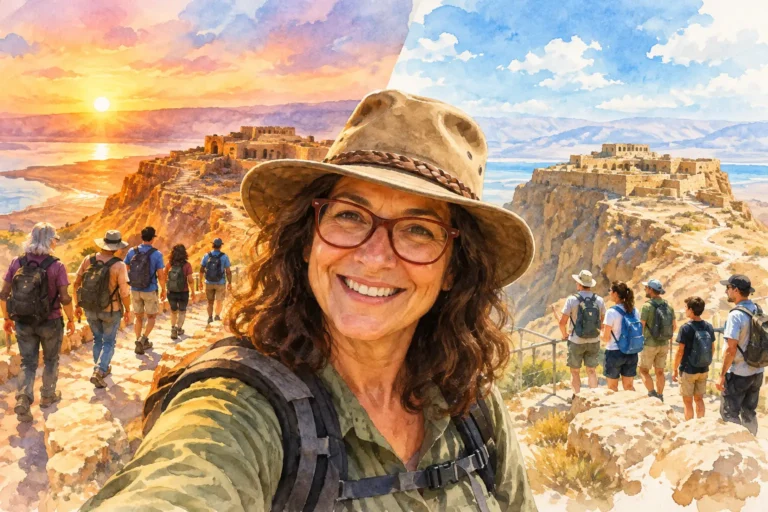
Masada Sunrise Versus Daytime – Which to Choose
The decision between Masada sunrise versus daytime can shape the entire feeling of your desert day. At dawn, you earn the view step by step as the Judean Desert changes from blue-gray to gold. Later in the morning, you can arrive rested, take the cable car, and give the fortress the time it deserves. Neither choice is automatically better. The right one depends on your energy, interests, season, and what you want to pair with Masada afterward.
Why the Timing Changes the Masada Experience
Masada is not simply a dramatic mountaintop ruin. It is a place of extraordinary contrasts: an isolated plateau above the Dead Sea, monumental palace terraces beside modest living quarters, sophisticated water systems in one of the driest landscapes, and wide desert horizons that make the site feel both remote and surprisingly close.
Sunrise emphasizes the landscape and the physical arrival. Daytime allows more attention for the archaeology, history, and small details that visitors can miss when they are focused on finishing a predawn climb. If you are traveling with a private guide, timing also determines how naturally Masada fits with the Dead Sea, a desert drive, a short hike, or a quieter stop that most standard itineraries pass by.
A note on seasonal conditions
In summer, the desert gets hot early, so a sunrise ascent can be the most comfortable time to hike. In winter, dawn can be chilly and windy, while a later visit may be much more pleasant. Weather, trail conditions, and site hours can change, so it is wise to confirm the current schedule before committing to an early start.
Masada at Sunrise: The Case for an Early Start
There is a reason Masada sunrise is on so many travelers’ wish lists. Most visitors climb the Snake Path from the eastern side, beginning in darkness with a flashlight or headlamp and reaching the plateau as first light spreads over the Dead Sea and the mountains beyond. It is an active, memorable entrance to one of Israel’s most evocative historic sites.
The climb is not technical, but it is real exercise. Expect a sustained uphill walk with uneven steps and a steady grade. A reasonably fit traveler often takes about 45 minutes to an hour, though the right pace is always the one that lets you arrive safely and enjoyably. Families with older children, active couples, and travelers who enjoy hiking often find that the effort becomes part of the story they remember most.
At the top, the initial reward is silence. Before the site fully wakes up, the plateau feels spacious, and the desert light reveals the scale of the landscape in a way photographs rarely capture. Sunrise is especially moving for travelers who value reflection, heritage, or a sense of personal achievement.
Still, sunrise is not a shortcut to a crowd-free Masada. It is popular, especially during comfortable hiking months and on busy travel dates. There may be many other people on the trail, though the shared anticipation can add to the atmosphere. The key difference is that everyone is oriented toward the same moment of light rather than arriving on a standard sightseeing schedule.
Who should choose sunrise?
Choose the sunrise option if you genuinely enjoy walking uphill, can comfortably manage an early wake-up, and want the desert to be as central to the experience as the fortress itself. It is also an excellent choice if you hope to float in the Dead Sea later, when the day has warmed up.
Skip the sunrise hike if you are traveling with very young children, have mobility concerns, are recovering from jet lag, or simply know that a 3:00 or 4:00 a.m. alarm will drain the joy from the day. A meaningful visit should not feel like an endurance test chosen for someone else’s vacation photo.
Masada During the Day: More Time for the Story
A daytime visit gives Masada room to unfold. You can usually take the cable car up from the eastern entrance and conserve your energy for walking around the summit. That makes the site more accessible to multigenerational families, travelers on a shorter business visit, and anyone who prefers history without a predawn workout.
Once on top, there is much more than one grand viewpoint. A thoughtful visit can trace the northern palace, ceremonial spaces, storerooms, bathhouse remains, synagogue, and the ingenious cistern system that helped sustain life on this isolated mountain. The broad views are still spectacular in full daylight, especially when clear skies reveal the deep blue of the Dead Sea against the pale desert cliffs.
Daytime is often the better choice for travelers who want interpretation rather than simply a summit moment. Masada’s power lies in the human scale of the place as well as its epic setting. With time to pause, you can see how planners adapted to the terrain, where water was stored, and how a fortified desert refuge became one of Israel’s most recognized heritage sites.
The trade-off is heat. From late spring through early fall, exposed paths on the plateau can be intense by midmorning. Bring more water than you think you need, wear sun protection, and choose breathable clothing and sturdy shoes. A broad-brimmed hat is not an accessory here. It is practical desert equipment.
The daytime route from the west
There is another daytime option for walkers: approaching Masada from the western side via the Roman Ramp. This is a shorter ascent than the Snake Path and can suit travelers who want to walk up without the full dawn experience. It also works well within a desert-focused itinerary that includes a scenic drive, a canyon walk, or other adventures in the region.
Masada Sunrise Versus Daytime: A Practical Comparison
If your priority is atmosphere, choose sunrise. The changing light, the early quiet, and the sense of reaching the fortress under your own power create a distinctly emotional experience.
If your priority is comfort and historical depth, choose daytime. You will have more flexibility, a less demanding arrival, and a better chance to explore at an unhurried pace. This is often the right answer for first-time visitors who want to understand what they are seeing, not simply check Masada off a list.
For travelers who have visited Israel before, the choice can be more creative. A sunrise hike may be paired with a relaxed Dead Sea morning and a desert meal. A daytime Masada visit may be combined with a lesser-known viewpoint, a short nature walk, or an encounter that adds texture to the region beyond its famous landmarks.
The best plan also depends on your group. A family with teenagers may love the shared challenge of a sunrise climb. A group of friends with varied fitness levels may prefer taking the cable car together and reserving their energy for a swim or spa stop afterward. For a limited-time visitor, a daytime visit can offer the strongest balance of impact and efficiency.
How to Make Either Visit Better
Whatever time you choose, do not treat Masada as a quick photo stop. Allow enough time on the summit to look beyond the first overlook. Start hydrated, carry water, and wear shoes that can handle stone paths. In hot weather, begin as early as practical even if you are not hiking for sunrise.
A guide adds particular value here because Masada can look deceptively simple from a distance. Its walls, terraces, and ruins come alive when connected to the people who built, supplied, defended, and lived within them. The landscape also becomes easier to read – the roads below, the camps in the desert, the sheer drop toward the Dead Sea, and the routes that made this mountain both vulnerable and formidable.
At Patchwork Israel, a Masada day can be designed around your own pace rather than a fixed bus schedule. That might mean a challenging sunrise hike, a cable-car visit with more historical context, or a desert day that continues well beyond the fortress.
Choose the hour that lets you be present. If dawn will make you feel alive, climb toward the light. If a slower morning will help you notice more, arrive later and let Masada tell its story one stone, view, and quiet corner at a time.

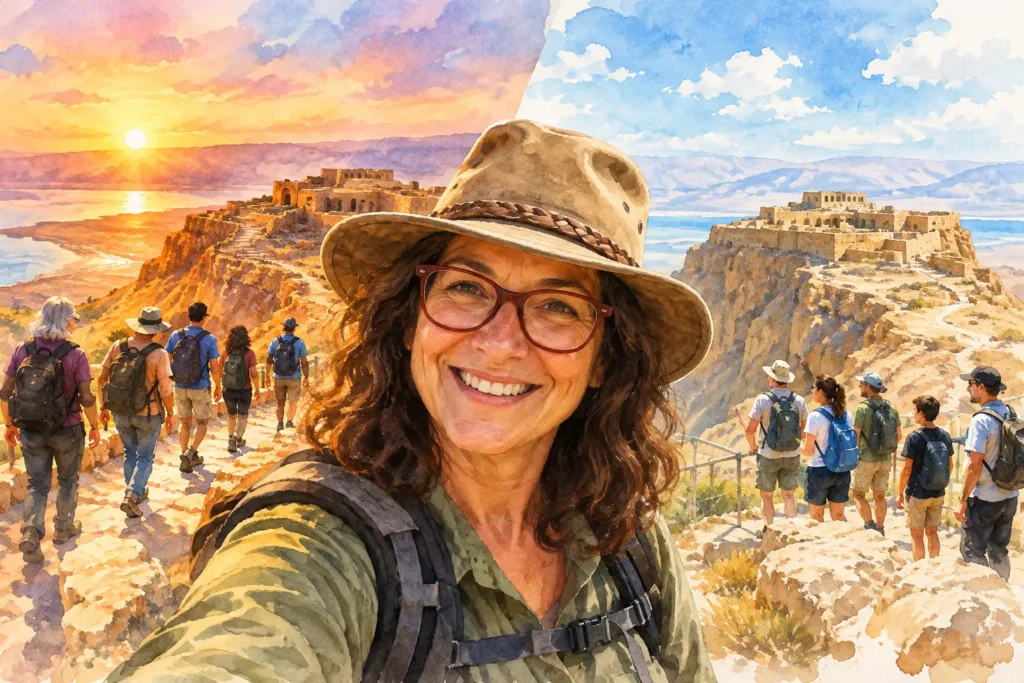
Masada Sunrise Versus Daytime – Which to Choose
The decision between Masada sunrise versus daytime can shape the entire feeling of your desert day. At dawn, you earn the view step by step as the Judean Desert changes from blue-gray to gold. Later in the morning, you can arrive rested, take the cable car, and give the fortress the time it deserves. Neither choice is automatically better. The right one depends on your energy, interests, season, and what you want to pair with Masada afterward.
Why the Timing Changes the Masada Experience
Masada is not simply a dramatic mountaintop ruin. It is a place of extraordinary contrasts: an isolated plateau above the Dead Sea, monumental palace terraces beside modest living quarters, sophisticated water systems in one of the driest landscapes, and wide desert horizons that make the site feel both remote and surprisingly close.
Sunrise emphasizes the landscape and the physical arrival. Daytime allows more attention for the archaeology, history, and small details that visitors can miss when they are focused on finishing a predawn climb. If you are traveling with a private guide, timing also determines how naturally Masada fits with the Dead Sea, a desert drive, a short hike, or a quieter stop that most standard itineraries pass by.
A note on seasonal conditions
In summer, the desert gets hot early, so a sunrise ascent can be the most comfortable time to hike. In winter, dawn can be chilly and windy, while a later visit may be much more pleasant. Weather, trail conditions, and site hours can change, so it is wise to confirm the current schedule before committing to an early start.
Masada at Sunrise: The Case for an Early Start
There is a reason Masada sunrise is on so many travelers’ wish lists. Most visitors climb the Snake Path from the eastern side, beginning in darkness with a flashlight or headlamp and reaching the plateau as first light spreads over the Dead Sea and the mountains beyond. It is an active, memorable entrance to one of Israel’s most evocative historic sites.
The climb is not technical, but it is real exercise. Expect a sustained uphill walk with uneven steps and a steady grade. A reasonably fit traveler often takes about 45 minutes to an hour, though the right pace is always the one that lets you arrive safely and enjoyably. Families with older children, active couples, and travelers who enjoy hiking often find that the effort becomes part of the story they remember most.
At the top, the initial reward is silence. Before the site fully wakes up, the plateau feels spacious, and the desert light reveals the scale of the landscape in a way photographs rarely capture. Sunrise is especially moving for travelers who value reflection, heritage, or a sense of personal achievement.
Still, sunrise is not a shortcut to a crowd-free Masada. It is popular, especially during comfortable hiking months and on busy travel dates. There may be many other people on the trail, though the shared anticipation can add to the atmosphere. The key difference is that everyone is oriented toward the same moment of light rather than arriving on a standard sightseeing schedule.
Who should choose sunrise?
Choose the sunrise option if you genuinely enjoy walking uphill, can comfortably manage an early wake-up, and want the desert to be as central to the experience as the fortress itself. It is also an excellent choice if you hope to float in the Dead Sea later, when the day has warmed up.
Skip the sunrise hike if you are traveling with very young children, have mobility concerns, are recovering from jet lag, or simply know that a 3:00 or 4:00 a.m. alarm will drain the joy from the day. A meaningful visit should not feel like an endurance test chosen for someone else’s vacation photo.
Masada During the Day: More Time for the Story
A daytime visit gives Masada room to unfold. You can usually take the cable car up from the eastern entrance and conserve your energy for walking around the summit. That makes the site more accessible to multigenerational families, travelers on a shorter business visit, and anyone who prefers history without a predawn workout.
Once on top, there is much more than one grand viewpoint. A thoughtful visit can trace the northern palace, ceremonial spaces, storerooms, bathhouse remains, synagogue, and the ingenious cistern system that helped sustain life on this isolated mountain. The broad views are still spectacular in full daylight, especially when clear skies reveal the deep blue of the Dead Sea against the pale desert cliffs.
Daytime is often the better choice for travelers who want interpretation rather than simply a summit moment. Masada’s power lies in the human scale of the place as well as its epic setting. With time to pause, you can see how planners adapted to the terrain, where water was stored, and how a fortified desert refuge became one of Israel’s most recognized heritage sites.
The trade-off is heat. From late spring through early fall, exposed paths on the plateau can be intense by midmorning. Bring more water than you think you need, wear sun protection, and choose breathable clothing and sturdy shoes. A broad-brimmed hat is not an accessory here. It is practical desert equipment.
The daytime route from the west
There is another daytime option for walkers: approaching Masada from the western side via the Roman Ramp. This is a shorter ascent than the Snake Path and can suit travelers who want to walk up without the full dawn experience. It also works well within a desert-focused itinerary that includes a scenic drive, a canyon walk, or other adventures in the region.
Masada Sunrise Versus Daytime: A Practical Comparison
If your priority is atmosphere, choose sunrise. The changing light, the early quiet, and the sense of reaching the fortress under your own power create a distinctly emotional experience.
If your priority is comfort and historical depth, choose daytime. You will have more flexibility, a less demanding arrival, and a better chance to explore at an unhurried pace. This is often the right answer for first-time visitors who want to understand what they are seeing, not simply check Masada off a list.
For travelers who have visited Israel before, the choice can be more creative. A sunrise hike may be paired with a relaxed Dead Sea morning and a desert meal. A daytime Masada visit may be combined with a lesser-known viewpoint, a short nature walk, or an encounter that adds texture to the region beyond its famous landmarks.
The best plan also depends on your group. A family with teenagers may love the shared challenge of a sunrise climb. A group of friends with varied fitness levels may prefer taking the cable car together and reserving their energy for a swim or spa stop afterward. For a limited-time visitor, a daytime visit can offer the strongest balance of impact and efficiency.
How to Make Either Visit Better
Whatever time you choose, do not treat Masada as a quick photo stop. Allow enough time on the summit to look beyond the first overlook. Start hydrated, carry water, and wear shoes that can handle stone paths. In hot weather, begin as early as practical even if you are not hiking for sunrise.
A guide adds particular value here because Masada can look deceptively simple from a distance. Its walls, terraces, and ruins come alive when connected to the people who built, supplied, defended, and lived within them. The landscape also becomes easier to read – the roads below, the camps in the desert, the sheer drop toward the Dead Sea, and the routes that made this mountain both vulnerable and formidable.
At Patchwork Israel, a Masada day can be designed around your own pace rather than a fixed bus schedule. That might mean a challenging sunrise hike, a cable-car visit with more historical context, or a desert day that continues well beyond the fortress.
Choose the hour that lets you be present. If dawn will make you feel alive, climb toward the light. If a slower morning will help you notice more, arrive later and let Masada tell its story one stone, view, and quiet corner at a time.


Get the latest blog updates in your inbox.