
How to Combine Faith and Adventure in Israel
A sunrise walk above the Judean Desert can change the way you enter Jerusalem later that day. The quiet, the wide horizon, and the effort of reaching a viewpoint create space for thoughts that a bus window rarely allows. That is the heart of how to combine faith and adventure in Israel: not treating spiritual places and active experiences as separate parts of a trip, but allowing each to deepen the other.
For some travelers, faith means prayer, Scripture, pilgrimage, or a family heritage story. For others, it is a search for perspective, gratitude, belonging, or a better understanding of the people and traditions that have shaped this small, remarkably varied country. An adventurous itinerary can serve all of those intentions when it is planned with care.
Begin with the reason you are traveling
Before choosing a trail, a sacred site, or a hotel, ask one useful question: what do you hope to carry home? A traveler returning to Israel may want to move beyond the major sites and encounter the country through a new lens. A family may want young adults to feel that a heritage journey is alive, not assigned. A business traveler with one free day may need a short experience that feels personal rather than rushed.
Your answer shapes the pace. A Catholic visitor may want unhurried time in the Galilee and a walk in the landscape around meaningful Gospel settings. A Jewish family may want to connect Jerusalem’s ancient stones with a hike that reveals the physical terrain behind familiar stories. Someone with no religious affiliation may be drawn to the same places through archaeology, architecture, food, and human conversation.
There is no single correct balance. Some travelers want a morning of prayer followed by an easy nature walk. Others feel most present when climbing Masada before dawn, rappelling into a desert canyon, or driving a 4×4 route through open country. The goal is not to make every activity spiritual. It is to create an itinerary with enough time, context, and breathing room for meaning to emerge.
How to combine faith and adventure without rushing
The most common mistake is treating meaningful travel as a checklist. Israel is compact on a map, but its roads, landscapes, and layers of history deserve time. Trying to fit Jerusalem, Masada, the Dead Sea, the Galilee, and Tel Aviv into a few overloaded days can leave travelers with photographs but little memory of how a place felt.
A better approach is to pair one anchor experience with one active, sensory experience each day. In Jerusalem, that might mean beginning at a site of personal importance, then walking lesser-known lanes, rooftops, or archaeological areas with a guide who can connect the stones to the larger story. In the north, it could mean a reflective visit in the morning followed by a forest hike, a farm visit, or a local cooking experience in the afternoon.
The pairing works because movement changes attention. After sitting in a chapel, synagogue, or ancient gathering place, a walk through hills or along a stream gives people time to process. After a demanding hike, arriving at a sacred viewpoint can feel earned rather than simply scheduled.
Let the landscape provide the context
Many stories of faith are also stories of geography. Desert routes explain the challenge of travel, wilderness, and refuge. Hillsides show why an ancient settlement stood where it did. Springs, valleys, and agricultural land reveal how communities survived and flourished.
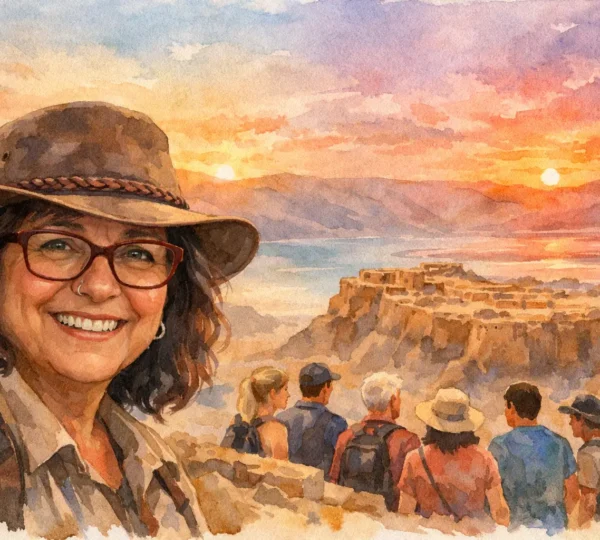
Masada is a powerful example. The cable car offers access for those who need it, while the Snake Path creates a very different emotional arrival for travelers who are able and eager to hike before the heat builds. Neither choice is more virtuous. The right choice depends on fitness, weather, timing, and what each traveler wants from the day. A knowledgeable guide can help a family make that decision safely, without turning a meaningful experience into an exhausting one.
The Dead Sea also asks for balance. Floating in its mineral-rich water is memorable, but it can be even more rewarding when combined with an early desert walk, a visit to an overlook, or time in a nearby nature reserve. The contrast between stark salt formations, deep silence, and life around a spring gives the region a depth that a quick stop cannot offer.
Make room for people, not only places
Faith becomes more vivid when travelers encounter the living communities, crafts, kitchens, and work behind a destination. A conversation with a local host, a baker, an artist, an archaeologist, or a farmer can turn a broad idea into a human connection. These moments also give travelers room to ask respectful questions and hear perspectives they would not find on a standard group itinerary.
This is especially valuable for people who have already visited Israel. The major landmarks may be familiar, but a small workshop, a home meal, a food market with purpose, or a meeting shaped around a particular interest can reveal an entirely different Israel. A lover of design may see an old city through architecture. A food-focused traveler may understand a region through spices, bread, and seasonal produce. A family with teenagers may find that hands-on activities create the conversations they hoped for.
Adventure helps here too. Foraging with a local expert, sailing along the coast, riding a camel in the desert, or taking an off-road route to a remote viewpoint offers a shared experience before the conversation even begins. It is easier to connect when everyone has done something together.
Choose adventure that fits your group
An adventurous trip does not have to mean extreme. Israel offers a wide range, from gentle walks and scenic 4×4 drives to challenging hikes, water activities, mountain excursions, and desert navigation. The best choice is the one that lets everyone participate with confidence.
For multigenerational families, a comfortable 4×4 excursion can reach beautiful areas while saving energy for a short walk and a picnic. For active adults, a sunrise hike may be the highlight of the week. For a youth group, an outdoor challenge can build trust and give historical learning a physical dimension. For travelers with limited time, even a two- or three-hour nature experience near a city can reset the whole trip.
It also matters when you travel. Desert hiking is often best in the cool hours, while summer days may call for shade, water, indoor cultural experiences, or a swim. Winter can transform streams and green hills, but it requires flexibility around rain and trail conditions. Good planning is not about forcing a fixed itinerary. It is about having thoughtful alternatives that still feel intentional.
Build in quiet moments
A meaningful day needs pauses. Leave time to sit at a viewpoint without narration, write in a journal, share a family memory over lunch, or simply walk in silence for a few minutes. These pauses are not empty space. They are often where a powerful site or a challenging trail becomes personally significant.
In Jerusalem, that may mean allowing time after a visit rather than immediately moving to the next attraction. In the desert, it may mean stopping the vehicle before sunset and watching the colors shift across the hills. In the Galilee, it could be a quiet shoreline moment after a full day of walking and learning.
A private, tailor-made tour makes these choices possible. You can stay longer where you feel connected and move on when you do not. Patchwork Israel builds days around the traveler rather than asking the traveler to keep pace with a preset bus schedule. That flexibility is particularly valuable when faith, family stories, curiosity, and physical ability all shape the same journey.
Travel with curiosity and respect
Sacred spaces are not museum displays. They are places where people pray, work, gather, and maintain traditions. Dress appropriately when requested, listen before photographing, and let your guide explain local expectations. Respect is not a restriction on a trip. It is what makes a more genuine encounter possible.
The same principle applies outdoors. Desert heat, uneven paths, and changing weather require preparation. Wear suitable footwear, carry water, protect yourself from the sun, and be honest about your pace. A well-chosen route should leave you energized and proud, not depleted for the experiences that follow.
The finest faith-and-adventure journeys do not insist that every traveler feel the same thing. They offer the setting, story, challenge, and time to be present. Stand on a trail before sunrise, listen to the wind move across the desert, and let the next meaningful moment arrive at its own pace.

How to Combine Faith and Adventure in Israel
A sunrise walk above the Judean Desert can change the way you enter Jerusalem later that day. The quiet, the wide horizon, and the effort of reaching a viewpoint create space for thoughts that a bus window rarely allows. That is the heart of how to combine faith and adventure in Israel: not treating spiritual places and active experiences as separate parts of a trip, but allowing each to deepen the other.
For some travelers, faith means prayer, Scripture, pilgrimage, or a family heritage story. For others, it is a search for perspective, gratitude, belonging, or a better understanding of the people and traditions that have shaped this small, remarkably varied country. An adventurous itinerary can serve all of those intentions when it is planned with care.
Begin with the reason you are traveling
Before choosing a trail, a sacred site, or a hotel, ask one useful question: what do you hope to carry home? A traveler returning to Israel may want to move beyond the major sites and encounter the country through a new lens. A family may want young adults to feel that a heritage journey is alive, not assigned. A business traveler with one free day may need a short experience that feels personal rather than rushed.
Your answer shapes the pace. A Catholic visitor may want unhurried time in the Galilee and a walk in the landscape around meaningful Gospel settings. A Jewish family may want to connect Jerusalem’s ancient stones with a hike that reveals the physical terrain behind familiar stories. Someone with no religious affiliation may be drawn to the same places through archaeology, architecture, food, and human conversation.
There is no single correct balance. Some travelers want a morning of prayer followed by an easy nature walk. Others feel most present when climbing Masada before dawn, rappelling into a desert canyon, or driving a 4×4 route through open country. The goal is not to make every activity spiritual. It is to create an itinerary with enough time, context, and breathing room for meaning to emerge.
How to combine faith and adventure without rushing
The most common mistake is treating meaningful travel as a checklist. Israel is compact on a map, but its roads, landscapes, and layers of history deserve time. Trying to fit Jerusalem, Masada, the Dead Sea, the Galilee, and Tel Aviv into a few overloaded days can leave travelers with photographs but little memory of how a place felt.
A better approach is to pair one anchor experience with one active, sensory experience each day. In Jerusalem, that might mean beginning at a site of personal importance, then walking lesser-known lanes, rooftops, or archaeological areas with a guide who can connect the stones to the larger story. In the north, it could mean a reflective visit in the morning followed by a forest hike, a farm visit, or a local cooking experience in the afternoon.
The pairing works because movement changes attention. After sitting in a chapel, synagogue, or ancient gathering place, a walk through hills or along a stream gives people time to process. After a demanding hike, arriving at a sacred viewpoint can feel earned rather than simply scheduled.
Let the landscape provide the context
Many stories of faith are also stories of geography. Desert routes explain the challenge of travel, wilderness, and refuge. Hillsides show why an ancient settlement stood where it did. Springs, valleys, and agricultural land reveal how communities survived and flourished.
Masada is a powerful example. The cable car offers access for those who need it, while the Snake Path creates a very different emotional arrival for travelers who are able and eager to hike before the heat builds. Neither choice is more virtuous. The right choice depends on fitness, weather, timing, and what each traveler wants from the day. A knowledgeable guide can help a family make that decision safely, without turning a meaningful experience into an exhausting one.
The Dead Sea also asks for balance. Floating in its mineral-rich water is memorable, but it can be even more rewarding when combined with an early desert walk, a visit to an overlook, or time in a nearby nature reserve. The contrast between stark salt formations, deep silence, and life around a spring gives the region a depth that a quick stop cannot offer.
Make room for people, not only places
Faith becomes more vivid when travelers encounter the living communities, crafts, kitchens, and work behind a destination. A conversation with a local host, a baker, an artist, an archaeologist, or a farmer can turn a broad idea into a human connection. These moments also give travelers room to ask respectful questions and hear perspectives they would not find on a standard group itinerary.
This is especially valuable for people who have already visited Israel. The major landmarks may be familiar, but a small workshop, a home meal, a food market with purpose, or a meeting shaped around a particular interest can reveal an entirely different Israel. A lover of design may see an old city through architecture. A food-focused traveler may understand a region through spices, bread, and seasonal produce. A family with teenagers may find that hands-on activities create the conversations they hoped for.
Adventure helps here too. Foraging with a local expert, sailing along the coast, riding a camel in the desert, or taking an off-road route to a remote viewpoint offers a shared experience before the conversation even begins. It is easier to connect when everyone has done something together.
Choose adventure that fits your group
An adventurous trip does not have to mean extreme. Israel offers a wide range, from gentle walks and scenic 4×4 drives to challenging hikes, water activities, mountain excursions, and desert navigation. The best choice is the one that lets everyone participate with confidence.
For multigenerational families, a comfortable 4×4 excursion can reach beautiful areas while saving energy for a short walk and a picnic. For active adults, a sunrise hike may be the highlight of the week. For a youth group, an outdoor challenge can build trust and give historical learning a physical dimension. For travelers with limited time, even a two- or three-hour nature experience near a city can reset the whole trip.
It also matters when you travel. Desert hiking is often best in the cool hours, while summer days may call for shade, water, indoor cultural experiences, or a swim. Winter can transform streams and green hills, but it requires flexibility around rain and trail conditions. Good planning is not about forcing a fixed itinerary. It is about having thoughtful alternatives that still feel intentional.
Build in quiet moments
A meaningful day needs pauses. Leave time to sit at a viewpoint without narration, write in a journal, share a family memory over lunch, or simply walk in silence for a few minutes. These pauses are not empty space. They are often where a powerful site or a challenging trail becomes personally significant.
In Jerusalem, that may mean allowing time after a visit rather than immediately moving to the next attraction. In the desert, it may mean stopping the vehicle before sunset and watching the colors shift across the hills. In the Galilee, it could be a quiet shoreline moment after a full day of walking and learning.
A private, tailor-made tour makes these choices possible. You can stay longer where you feel connected and move on when you do not. Patchwork Israel builds days around the traveler rather than asking the traveler to keep pace with a preset bus schedule. That flexibility is particularly valuable when faith, family stories, curiosity, and physical ability all shape the same journey.
Travel with curiosity and respect
Sacred spaces are not museum displays. They are places where people pray, work, gather, and maintain traditions. Dress appropriately when requested, listen before photographing, and let your guide explain local expectations. Respect is not a restriction on a trip. It is what makes a more genuine encounter possible.
The same principle applies outdoors. Desert heat, uneven paths, and changing weather require preparation. Wear suitable footwear, carry water, protect yourself from the sun, and be honest about your pace. A well-chosen route should leave you energized and proud, not depleted for the experiences that follow.
The finest faith-and-adventure journeys do not insist that every traveler feel the same thing. They offer the setting, story, challenge, and time to be present. Stand on a trail before sunrise, listen to the wind move across the desert, and let the next meaningful moment arrive at its own pace.
Get the latest blog updates in your inbox.