
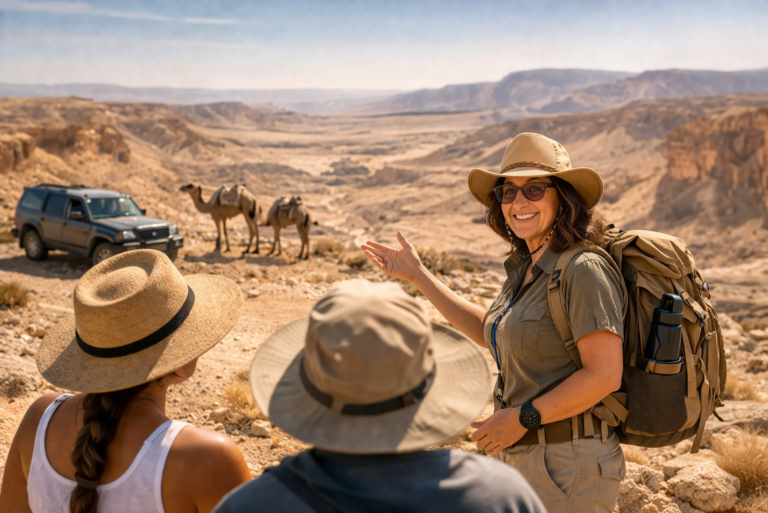
Desert Tours in Israel That Feel Personal
The desert changes the way people experience Israel. A sunrise over the Ramon Crater, the silence above Zin Canyon, the sharp light on ancient stone near Masada – these are not filler days between city stops. The best desert tours in Israel become the moments travelers talk about longest, because the landscape strips things back and lets history, culture, and nature come forward in a very direct way.
For some travelers, that means hiking to a lookout and sitting quietly with coffee. For others, it means a 4×4 route through rough terrain, a desert monastery, a Bedouin-style hospitality experience, or a full day that moves from geology to archaeology to the Dead Sea. The key is not choosing the most famous desert stop. It is choosing the right kind of desert day for the way you like to travel.
Why desert tours in Israel stand out
Israel’s desert is not one thing. The Negev alone can feel wide and cinematic in one area, intimate and deeply human in another. You can spend a morning among dramatic erosion formations and by afternoon be in a small community, at an overlook tied to biblical memory, or at an archaeological site that gives shape to the story of the land.
That variety matters. Many visitors assume a desert day will be mostly scenery. In reality, the strongest desert touring often combines layers – landscapes, sacred associations, history, local life, and movement. A well-built route can appeal to Jews, Christians, Muslims, Alawites, Druze, and non-religious travelers alike because the desert is not presented as a single narrative. It holds many.
There is also a practical advantage. Desert touring gives breathing room to an Israel itinerary. Jerusalem can be intense. Tel Aviv can be fast-paced. The Galilee can be rich and full. The desert offers space, different light, and a slower rhythm, even when the day itself is active.
Choosing the right desert experience
Not every traveler wants the same desert. That sounds obvious, but it is where many tours go wrong. A standard route may check famous boxes and still feel flat if the pace, physical level, or focus does not match the people in the vehicle.
If you love landscapes and photography, the Ramon Crater region is hard to beat. It has scale, texture, and constantly changing color, especially early and late in the day. If you want a desert day anchored in history, the Judean Desert around Masada and the Dead Sea often makes more sense. If you are traveling with older family members or children, you may want a route with shorter walks, shaded stops where possible, and fewer long transfer times.
There is also the question of energy. Some travelers want a contemplative day with scenic drives, overlooks, and selected short walks. Others want to feel the ground under their boots, climb, descend, and earn the views. Neither is better. It just depends what kind of memory you are trying to create.
Best regions for desert tours in Israel
The Judean Desert
This is often the best fit for first-time visitors who want drama without traveling too far from Jerusalem. The terrain is stark and immediate, with deep wadis, cliffside monasteries, powerful lookout points, and routes that connect naturally with Masada and the Dead Sea.
The advantage here is contrast. You can leave a dense historic city and within a relatively short drive be in a very different world. For travelers interested in sacred geography, ancient roads, and desert spirituality, this region has unusual depth.
The Negev Desert
The Negev is broader in mood and possibility. It can be excellent for repeat visitors who have already seen Israel’s major landmarks and want something less expected. Here, desert touring can include hiking, 4×4 off-roading, crater landscapes, Nabataean history, agricultural innovation, artisan encounters, and lesser-known viewpoints that do not feel crowded or overworked.
This is also where customization really shines. One traveler may want a geology-focused day. Another may want a desert winery, an overlook, and a soft adventure route. A family may want movement and space without an exhausting hike. The Negev can absorb all of those approaches.
Ramon Crater and Mitzpe Ramon
If your image of the desert is big horizons and a sense of awe, this area usually delivers. Ramon Crater is one of the most memorable landscapes in the country, and it works well for travelers who want either a scenic day or a more active one. Walking routes can be tailored, and 4×4 access opens parts of the terrain that feel remote without requiring advanced hiking fitness.
The trade-off is distance. If your schedule is tight, rushing in and out can make the day feel too long in the car. This area is best when given enough time to breathe.
What a personalized desert day can include
A customized route is not just about private transportation. It is about building a day around what actually interests you and what your body wants from the day.
For some travelers, that starts with timing. Early departures are often worth it in the desert because the light is better and the temperatures are kinder. For others, especially on slower-paced vacations, a later start with a scenic route and fewer strenuous stops feels more realistic.
The activities can vary widely. A desert day might include a moderate hike, an overlook with a conversation about the geology of the rift landscape, a visit to an ancient site, and time to float in the Dead Sea. It might instead focus on a 4×4 route, hidden corners most travelers miss, and a stop for a meal that feels rooted in the region rather than generic. Some travelers want cultural encounters and conversation. Others want stillness.
That is where an experienced guide makes a difference. The desert can look simple from a distance, but the best days come from knowing which routes are beautiful in the current season, which stops fit your pace, and where the hidden gems really are. On a tailor-made trip with Patchwork Israel, that is often the difference between a day that was nice and a day that felt like it was made for you.
Desert tours in Israel for different travelers
Couples often do well with scenic pacing, sunrise or late-afternoon light, and a route that leaves room for quiet. Families usually benefit from variety – not an endless hike, but a mix of movement, viewpoints, stories, and one or two memorable activities. Heritage travelers may want the desert connected to biblical, Second Temple, monastic, or early settlement history.
Repeat visitors are a special case. If you have already done Jerusalem, Masada, and the standard highlights, the desert opens a different Israel. This is where in-depth guiding matters. You can look at lesser-known sites, communities, hidden routes, and conversations that give shape to life beyond the usual itinerary.
Adventure-oriented travelers may naturally gravitate toward hiking or 4×4 touring, but even here, balance matters. A full-throttle day sounds appealing until heat, driving time, and fatigue catch up. The strongest active itineraries leave some margin for wonder.
When to go and what to expect
The desert is possible year-round, but not every season suits every style of touring. Cooler months are generally best for hiking and longer outdoor days. Summer can still work well if the itinerary is designed intelligently – very early starts, lighter walking, more driving between key points, and realistic expectations.
Weather in the desert is part of the experience, not just a background detail. Light changes fast. Temperatures swing more than many visitors expect. Wind can appear out of nowhere. This does not make desert travel difficult, but it does reward thoughtful planning.
Footwear matters. Water matters more. And pacing matters most of all. A good desert day should feel satisfying, not punishing.
The value of going with a guide who knows the land deeply
A desert map can show roads, trails, and named landmarks. It cannot tell you which overlook is worth the stop at a certain hour, which route is too ambitious for your group, or how to connect a wild landscape to the human stories that make it memorable.
That is why guided desert touring works so well in Israel. The places are compact enough to combine meaningfully, but only if someone knows how to shape the day. A seasoned licensed guide brings safety, context, timing, and flexibility. She also knows when to leave room for the landscape to speak for itself.
The best desert tours do not feel rushed or overly scripted. They feel attentive. They reflect your interests, your pace, your questions, and your curiosity. In a place as layered as Israel, that kind of guidance turns the desert from a scenic backdrop into a real encounter.
If the cities give you Israel’s voices, the desert gives you its space. And sometimes space is exactly what lets a journey become personal.

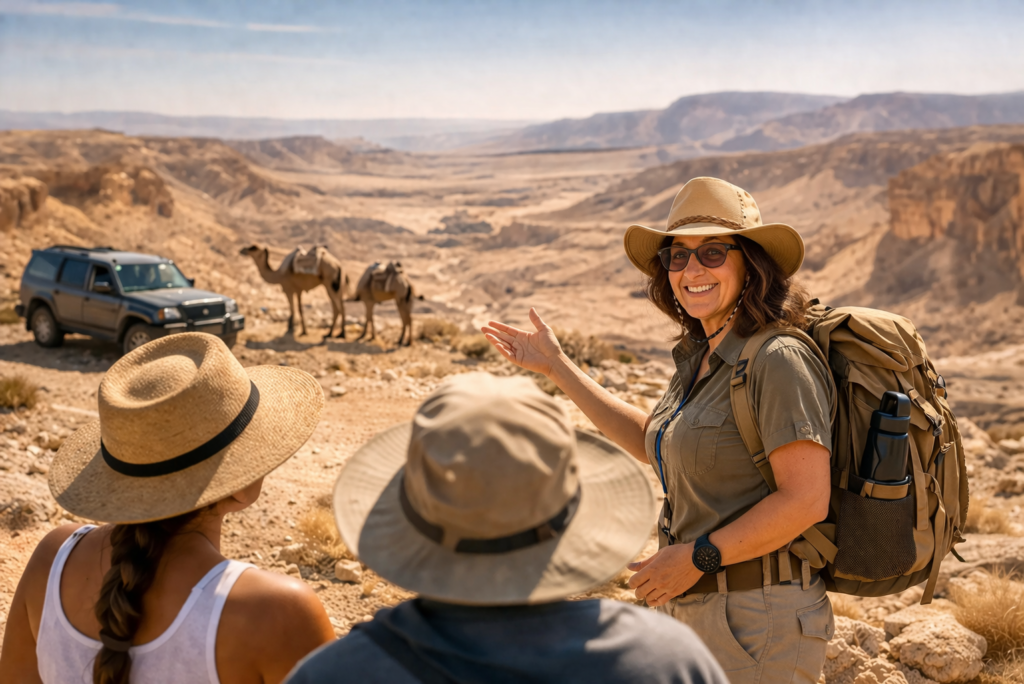
Desert Tours in Israel That Feel Personal
The desert changes the way people experience Israel. A sunrise over the Ramon Crater, the silence above Zin Canyon, the sharp light on ancient stone near Masada – these are not filler days between city stops. The best desert tours in Israel become the moments travelers talk about longest, because the landscape strips things back and lets history, culture, and nature come forward in a very direct way.
For some travelers, that means hiking to a lookout and sitting quietly with coffee. For others, it means a 4×4 route through rough terrain, a desert monastery, a Bedouin-style hospitality experience, or a full day that moves from geology to archaeology to the Dead Sea. The key is not choosing the most famous desert stop. It is choosing the right kind of desert day for the way you like to travel.
Why desert tours in Israel stand out
Israel’s desert is not one thing. The Negev alone can feel wide and cinematic in one area, intimate and deeply human in another. You can spend a morning among dramatic erosion formations and by afternoon be in a small community, at an overlook tied to biblical memory, or at an archaeological site that gives shape to the story of the land.
That variety matters. Many visitors assume a desert day will be mostly scenery. In reality, the strongest desert touring often combines layers – landscapes, sacred associations, history, local life, and movement. A well-built route can appeal to Jews, Christians, Muslims, Alawites, Druze, and non-religious travelers alike because the desert is not presented as a single narrative. It holds many.
There is also a practical advantage. Desert touring gives breathing room to an Israel itinerary. Jerusalem can be intense. Tel Aviv can be fast-paced. The Galilee can be rich and full. The desert offers space, different light, and a slower rhythm, even when the day itself is active.
Choosing the right desert experience
Not every traveler wants the same desert. That sounds obvious, but it is where many tours go wrong. A standard route may check famous boxes and still feel flat if the pace, physical level, or focus does not match the people in the vehicle.
If you love landscapes and photography, the Ramon Crater region is hard to beat. It has scale, texture, and constantly changing color, especially early and late in the day. If you want a desert day anchored in history, the Judean Desert around Masada and the Dead Sea often makes more sense. If you are traveling with older family members or children, you may want a route with shorter walks, shaded stops where possible, and fewer long transfer times.
There is also the question of energy. Some travelers want a contemplative day with scenic drives, overlooks, and selected short walks. Others want to feel the ground under their boots, climb, descend, and earn the views. Neither is better. It just depends what kind of memory you are trying to create.
Best regions for desert tours in Israel
The Judean Desert
This is often the best fit for first-time visitors who want drama without traveling too far from Jerusalem. The terrain is stark and immediate, with deep wadis, cliffside monasteries, powerful lookout points, and routes that connect naturally with Masada and the Dead Sea.
The advantage here is contrast. You can leave a dense historic city and within a relatively short drive be in a very different world. For travelers interested in sacred geography, ancient roads, and desert spirituality, this region has unusual depth.
The Negev Desert
The Negev is broader in mood and possibility. It can be excellent for repeat visitors who have already seen Israel’s major landmarks and want something less expected. Here, desert touring can include hiking, 4×4 off-roading, crater landscapes, Nabataean history, agricultural innovation, artisan encounters, and lesser-known viewpoints that do not feel crowded or overworked.
This is also where customization really shines. One traveler may want a geology-focused day. Another may want a desert winery, an overlook, and a soft adventure route. A family may want movement and space without an exhausting hike. The Negev can absorb all of those approaches.
Ramon Crater and Mitzpe Ramon
If your image of the desert is big horizons and a sense of awe, this area usually delivers. Ramon Crater is one of the most memorable landscapes in the country, and it works well for travelers who want either a scenic day or a more active one. Walking routes can be tailored, and 4×4 access opens parts of the terrain that feel remote without requiring advanced hiking fitness.
The trade-off is distance. If your schedule is tight, rushing in and out can make the day feel too long in the car. This area is best when given enough time to breathe.
What a personalized desert day can include
A customized route is not just about private transportation. It is about building a day around what actually interests you and what your body wants from the day.
For some travelers, that starts with timing. Early departures are often worth it in the desert because the light is better and the temperatures are kinder. For others, especially on slower-paced vacations, a later start with a scenic route and fewer strenuous stops feels more realistic.
The activities can vary widely. A desert day might include a moderate hike, an overlook with a conversation about the geology of the rift landscape, a visit to an ancient site, and time to float in the Dead Sea. It might instead focus on a 4×4 route, hidden corners most travelers miss, and a stop for a meal that feels rooted in the region rather than generic. Some travelers want cultural encounters and conversation. Others want stillness.
That is where an experienced guide makes a difference. The desert can look simple from a distance, but the best days come from knowing which routes are beautiful in the current season, which stops fit your pace, and where the hidden gems really are. On a tailor-made trip with Patchwork Israel, that is often the difference between a day that was nice and a day that felt like it was made for you.
Desert tours in Israel for different travelers
Couples often do well with scenic pacing, sunrise or late-afternoon light, and a route that leaves room for quiet. Families usually benefit from variety – not an endless hike, but a mix of movement, viewpoints, stories, and one or two memorable activities. Heritage travelers may want the desert connected to biblical, Second Temple, monastic, or early settlement history.
Repeat visitors are a special case. If you have already done Jerusalem, Masada, and the standard highlights, the desert opens a different Israel. This is where in-depth guiding matters. You can look at lesser-known sites, communities, hidden routes, and conversations that give shape to life beyond the usual itinerary.
Adventure-oriented travelers may naturally gravitate toward hiking or 4×4 touring, but even here, balance matters. A full-throttle day sounds appealing until heat, driving time, and fatigue catch up. The strongest active itineraries leave some margin for wonder.
When to go and what to expect
The desert is possible year-round, but not every season suits every style of touring. Cooler months are generally best for hiking and longer outdoor days. Summer can still work well if the itinerary is designed intelligently – very early starts, lighter walking, more driving between key points, and realistic expectations.
Weather in the desert is part of the experience, not just a background detail. Light changes fast. Temperatures swing more than many visitors expect. Wind can appear out of nowhere. This does not make desert travel difficult, but it does reward thoughtful planning.
Footwear matters. Water matters more. And pacing matters most of all. A good desert day should feel satisfying, not punishing.
The value of going with a guide who knows the land deeply
A desert map can show roads, trails, and named landmarks. It cannot tell you which overlook is worth the stop at a certain hour, which route is too ambitious for your group, or how to connect a wild landscape to the human stories that make it memorable.
That is why guided desert touring works so well in Israel. The places are compact enough to combine meaningfully, but only if someone knows how to shape the day. A seasoned licensed guide brings safety, context, timing, and flexibility. She also knows when to leave room for the landscape to speak for itself.
The best desert tours do not feel rushed or overly scripted. They feel attentive. They reflect your interests, your pace, your questions, and your curiosity. In a place as layered as Israel, that kind of guidance turns the desert from a scenic backdrop into a real encounter.
If the cities give you Israel’s voices, the desert gives you its space. And sometimes space is exactly what lets a journey become personal.

Get the latest blog updates in your inbox.